
We only source the best leather
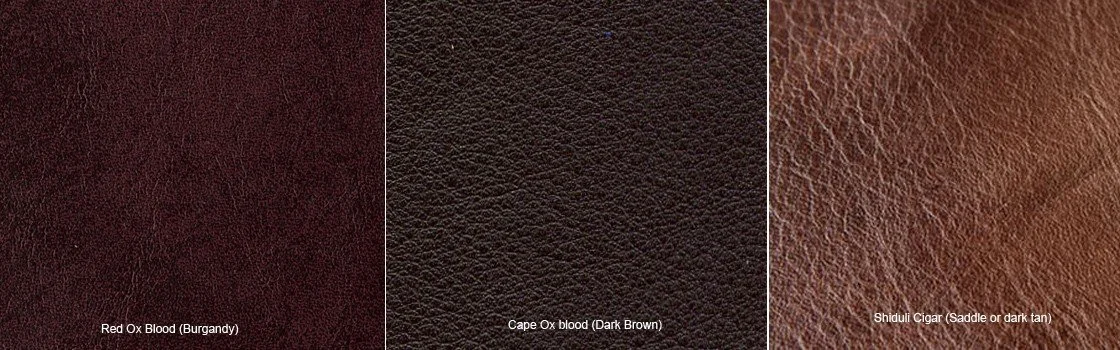
Leather swatches – visit our showroom to see and feel the full range.
The four forms of leather
Full-grain leather
Full-grain leather comes from hides that have not been sanded, buffed or snuffed to remove imperfections or natural marks from the surface. The grain remains, giving the leather its fibre strength, durability and breathability. Rather than wearing out, it develops a patina over time. High-quality leather furniture is often made from full-grain leather, typically in aniline or semi-aniline finishes.
Top-grain leather
Top-grain (semi-corrected) leather is the second-highest quality and the most common type in high-end leather products. The split layer has been removed, making it thinner and more pliable than full-grain. Its surface is sanded and finished, which gives a cooler feel with less breathability, and it will not develop a natural patina. It is typically less expensive and more stain-resistant than full-grain, as long as the finish remains unbroken.
Corrected-grain leather
Corrected-grain leather has an artificial grain applied to its surface. Imperfections are sanded off, an artificial grain is impressed into the surface and it is dressed with stain or dye. Most corrected-grain leather is used for pigmented leather, as the solid pigment helps hide the corrections. It is mainly available in semi-aniline and pigmented finishes.
Split leather
Split leather is made from the fibrous part of the hide left once the top grain has been separated. An artificial layer is applied to the surface and embossed with a leather grain. Splits are also used to make suede.
Not "true" leathers
The following materials contain leather fibre and may still be labelled "genuine leather", even though you can only see the outer layer:
Bycast leather is split leather with a layer of polyurethane laminated to the surface and embossed. It is stiffer but cheaper than top-grain leather, with a very consistent texture. Because the surface is covered in plastic it is easy to clean, but not easily repaired.
Bonded leather ("reconstituted leather") is made from leather offcuts that are shredded and bonded together with polyurethane or latex on a fibre sheet. The leather content (10%–90%) affects its smell and texture, and its durability varies widely.
Artificial leather (leather cloth) has a leather-like surface but contains no leather. It was traditionally used to cover chairs and line desk and table tops.
Hannitan Leather
Hannitan Leather, under the management of Rudolf Hanni, has been hailed as one of the cleanest and most efficient tanneries in the world. From humble beginnings it has grown into the largest supplier of furniture leather in South Africa, producing an average of 1,200 hides a day.
The tannery produces a wide variety of upholstery leathers, including aniline, semi-aniline, full-grain, corrected-grain, buffed leathers and oil pull-ups, in a huge selection of colours (any colour, subject to quantities).